Amber Dilemma Zone: Driver Cognition and Signal Control in Urban Traffic (1.0.0)
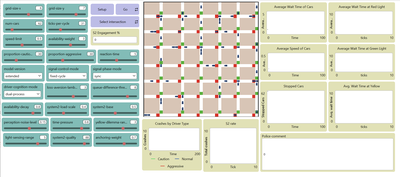
This model is an extension of Wilensky’s (2003) Traffic Grid, a foundational NetLogo model of urban traffic flow. It embeds a dual-process cognitive architecture into each driver agent, transforming the original’s identical reactive units into cognitively heterogeneous individuals whose internal mental state evolves with experience; making the same intersection produce different decisions from different drivers, and different decisions from the same driver across occasions. The core question the model addresses is the yellow-light dilemma zone: the seconds following amber onset in which a driver can neither stop safely nor clear the intersection before red. Field research documents that behavioral variance at this moment cannot be explained by geometry or legal obligation alone. This model provides the cognitive architecture that has been missing from traffic ABMs. Each driver routes every amber-onset decision through either System 1 (fast, heuristic, automatic) or System 2 (slow, deliberative, prospect-theoretic), switching dynamically based on cognitive load, accumulated near-miss memory, and situational framing. The result is crash outcomes that are attributable, path-dependent, and sensitive to both driver disposition and signal infrastructure; none of which fixed-rule models can reproduce. Three signal control modes are included: fixed-cycle (replicating Wilensky’s original), adaptive-queue, and smart occupancy-based switching.
Release Notes
Version 1.0.0. Initial public release. Extends Wilensky’s (2003) Traffic Grid with a dual-process (System 1 / System 2) cognitive architecture for amber-onset decisions at the signalized intersection dilemma zone. Includes three signal control modes (fixed-cycle, adaptive-queue, smart occupancy-based), three heterogeneous driver types, near-miss availability memory with decay, and prospect-theoretic System 2 valuation. Release contains the NetLogo 7.0 model (.nlogox), full model documentation with ODD protocol (PDF), and example simulation outputs for all four paper scenarios at tick 2,000 (CSV). Developed for the associated paper “Dual-Process Cognition at the Dilemma Zone: An Agent-Based Model of Urban Traffic Behavior.”
Associated Publications
Paper Title: Dual-Process Cognition at the Dilemma Zone: An Agent-Based Model of Urban Traffic Behavior
This is a companion discussion topic for the original entry at https://www.comses.net/codebases/a9b7d36e-e455-4324-988c-8d69d063ec2e/releases/1.0.0/